
MenstruTech ?
The term MenstruTech was coined by journalist Lucie Ronfaut to describe digital technologies for menstrual management, such as smartphone applications for tracking menstrual cycles. It echoes the term FemTech, popularized by Ida Tin, founder of Clue, to refer to the broader market dedicated to innovative technologies for women’s health.
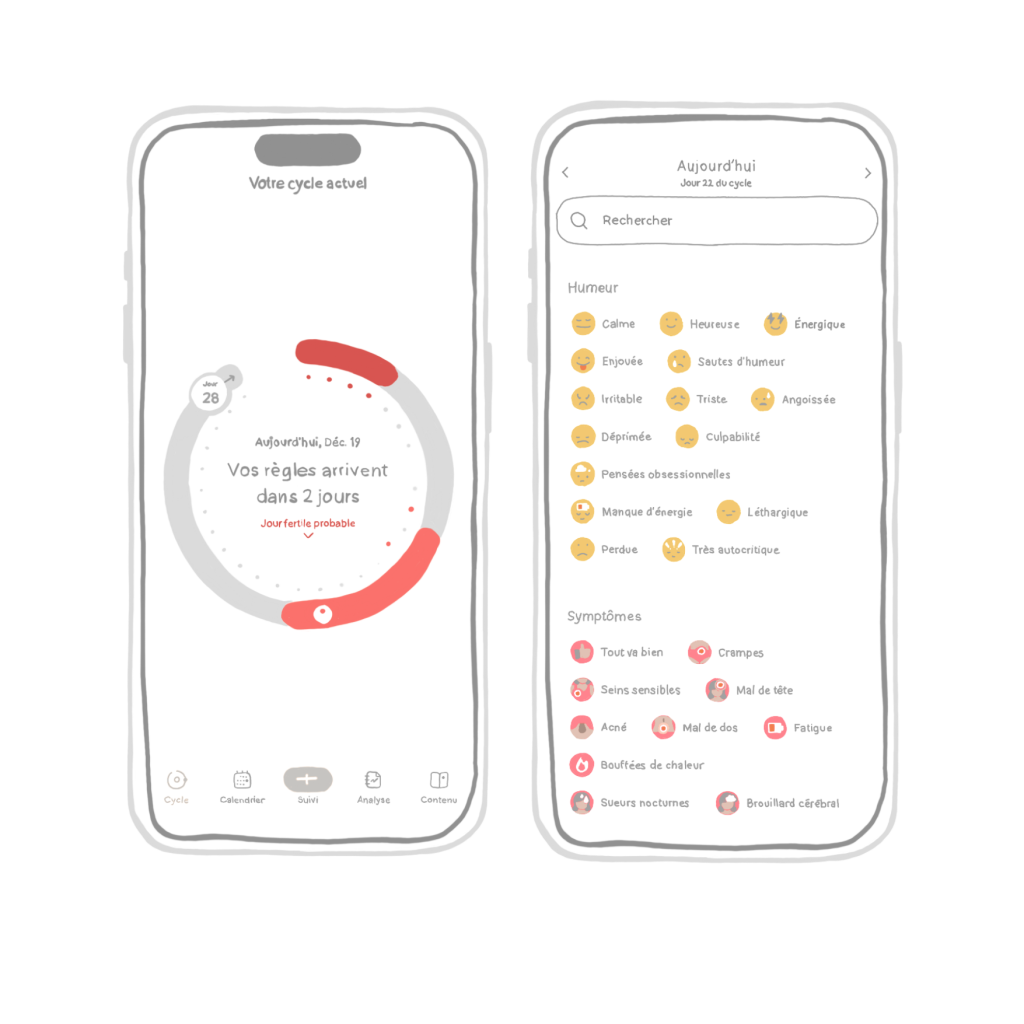
Menstrual cycle tracking applications began appearing on our smartphones in the mid-2010s and now number in the hundreds in the Google and Apple app stores. The best known among them, such as Clue or Flo, now claim several million users worldwide.
These applications invite users to enter the dates of their periods in order to receive predictions and notifications: the date of the next period, ovulation, premenstrual syndrome, and more. Beyond anticipating upcoming periods, these apps can also be used to better understand one’s body, to monitor painful symptoms and identify their causes, to complement or replace a contraceptive method, or as an aid to conception.
Blood and Data Flows
Studying the Role of Cycle Tracking Applications
in the Production of Menstrual Knowledge
MenstruTech is also the name of our research project, which aims to better understand these technologies and the actors involved. Our research focuses on the people who use these applications, (cisgender women, but also transgender and non-binary people) those who design and those who regulate them. We are also interested in privacy and personal data protection issues, as well as researchers and healthcare professionals engaging with these new research and care technologies. Finally, in a context of growing threats to abortion rights, our team also conducts ongoing monitoring of the potential risks associated with these applications.
The project is led by Marion Coville, Associate Professor in Information and Communication Sciences at Université de Poitiers. Initial studies have been conducted since 2018. MenstruTech has been supported and funded by the Agence Nationale de la Recherche since 2024, under the ANR JCJC program. Fieldwork on open-source and alternative MenstruTech initiatives was carried out through the Open Fellowship program of the Weizenbaum Institute in June 2025. Research focusing on education and teenagers has also received funding from the Région Nouvelle-Aquitaine since 2025.
Our research
Uses and users
Users, Healthcare and Education Professionals
How do users produce knowledge about their own bodies?
How do people navigate these interfaces when they are trans or non-binary?
How do these tools shape the bodily experiences of those who use them?
What role do these applications play in the relationship between patients and healthcare professionals?
How do sexual health education practitioners approach these new tools?
Behind the scene
Designers, Researchers, Institutions
What role do users’ personal data play in the business models of these applications, and what does this mean for their privacy?
How do the designers of these apps manage the balance between user experience, the communication of scientific knowledge, and economic profitability?
How do researchers use data generated by these applications to produce knowledge about menstruation?
How do these activities contribute to producing (or challenging) bodily, sexual, and scientific norms?